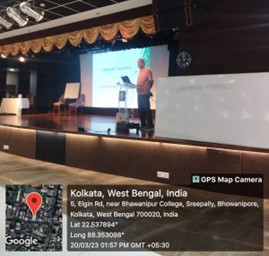
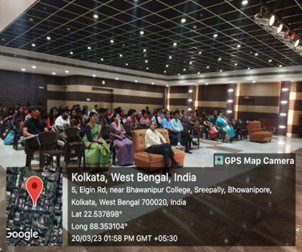
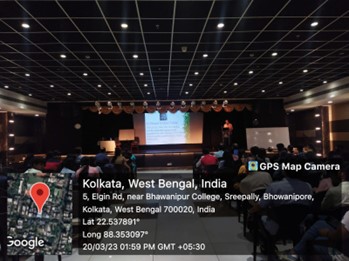
An Invited Lecture organized by the Department of Economics for the students and faculty of the Science Section, titled “Conventional to Classical Computing”, was delivered by respected Professor Kashinath Dey, ex-Professor of the Department of Computer Science and Engineering, University of Calcutta. The purpose of the lecture was to familiarize students with computing technologies that had been developed in ancient India and can still be applied successfully as a substitute of modern computing techniques.
The program touched off with a felicitation of the dignitary on-stage, following which the Dean of Students Affairs of the College, Professor Dilip Shah, shared his thoughts on the topic. The immersive lecture delivered by Professor Kashinath Dey consisted of little details of Vedic Mathematics and some of the sixteen sutras of the Vedas. Every sum presented to the undergraduate students was dealt with simple diction and ample clarity by the Professor. The importance of Vedas, Upvedas, and Vedangas in classical computing, and how their texts contained mathematical concepts that formed the core of Indian, and later, world mathematics and sciences, was talked about at length by the Professor.
He displayed some methods of performing basic subtraction and multiplication using techniques of computing that existed hundreds of years before conventional methods were thought of. Concepts of Ekanyunea Purvena and the importance of Sthapathyaveda, which, plainly put, is modern-day engineering, were expounded upon by the Professor. The reason behind ‘9’ being called as a ‘magic number’ was explained thoroughly by the distinguished teacher. He went on to talk about digital roots and their significance in classical computing, and how they can be used in today’s world to further simplify mathematics and science. Squaring numbers, or multiplying extremely large numbers, can be made out in a matter of minutes, if not seconds, using basic Vedic mathematics. The Professor emphasized on rigorous practice to get acquainted with the procedures, which might seem complicated to a first-timer, but invariably gets easier with repeated application.
The Professor graciously accepted questions from the audience pertaining to his lecture, after his presentation ended. Questions were asked by both students and teachers which were answered very promptly by the Professor. At the end of the lecture, Dr. Ivy Dasgupta delivered her vote of thanks and concluded the event.
A Faculty Development Programme is designed to bridge the gap in quality research and teaching skills that are required in contemporary management education in India. The Bhawanipur Education Society College has been committed to excellence in education, research, and training, as well as the utilisation of contemporary participant-centric pedagogies and teaching methodologies, in order to …
Category of the Activity (EXTENSION/OUTREACH/ENVIRONMENTAL): Outreach Organising unit: NSS Date/ duration of the activity: 12.04.2025 Time: 9am-4pm No. of Participants: 25 No. of Beneficiaries: N.A. Objective of the event: To encourage local community participation and sense of responsibility in preserving Ganga’s heritage and showcase the impact of collective efforts in maintaining a clean environment through …
A workshop on Family Managed Business was held on February 11th in the Concept Hall of the College from 11:00 am to 1:00 pm. The event was anchored by Prof. Parimal Merchant, Director Global FMB, SP Jain School of Global Management.
On 12th September, Monday, Eco for Be-ites collective of the Bhawanipur Education Society College conducted a seminar on case study & it’s application. Prof. Samprit Chakraborty, Dean academics of IBS Kolkata along with Mr. Abhishek Kundu- DGM east were the speakers of the event. They were accompanied by Mr. Tathagata Banerjee- Chief Manager IBS and …
Conventional to Classical Computing
An Invited Lecture organized by the Department of Economics for the students and faculty of the Science Section, titled “Conventional to Classical Computing”, was delivered by respected Professor Kashinath Dey, ex-Professor of the Department of Computer Science and Engineering, University of Calcutta. The purpose of the lecture was to familiarize students with computing technologies that had been developed in ancient India and can still be applied successfully as a substitute of modern computing techniques.
The program touched off with a felicitation of the dignitary on-stage, following which the Dean of Students Affairs of the College, Professor Dilip Shah, shared his thoughts on the topic. The immersive lecture delivered by Professor Kashinath Dey consisted of little details of Vedic Mathematics and some of the sixteen sutras of the Vedas. Every sum presented to the undergraduate students was dealt with simple diction and ample clarity by the Professor. The importance of Vedas, Upvedas, and Vedangas in classical computing, and how their texts contained mathematical concepts that formed the core of Indian, and later, world mathematics and sciences, was talked about at length by the Professor.
He displayed some methods of performing basic subtraction and multiplication using techniques of computing that existed hundreds of years before conventional methods were thought of. Concepts of Ekanyunea Purvena and the importance of Sthapathyaveda, which, plainly put, is modern-day engineering, were expounded upon by the Professor. The reason behind ‘9’ being called as a ‘magic number’ was explained thoroughly by the distinguished teacher. He went on to talk about digital roots and their significance in classical computing, and how they can be used in today’s world to further simplify mathematics and science. Squaring numbers, or multiplying extremely large numbers, can be made out in a matter of minutes, if not seconds, using basic Vedic mathematics. The Professor emphasized on rigorous practice to get acquainted with the procedures, which might seem complicated to a first-timer, but invariably gets easier with repeated application.
The Professor graciously accepted questions from the audience pertaining to his lecture, after his presentation ended. Questions were asked by both students and teachers which were answered very promptly by the Professor. At the end of the lecture, Dr. Ivy Dasgupta delivered her vote of thanks and concluded the event.
Related Posts
FACULTY DEVELOPMENT PROGRAMME
A Faculty Development Programme is designed to bridge the gap in quality research and teaching skills that are required in contemporary management education in India. The Bhawanipur Education Society College has been committed to excellence in education, research, and training, as well as the utilisation of contemporary participant-centric pedagogies and teaching methodologies, in order to …
Lets know Ganga- A ganga heritage preservation initiative
Category of the Activity (EXTENSION/OUTREACH/ENVIRONMENTAL): Outreach Organising unit: NSS Date/ duration of the activity: 12.04.2025 Time: 9am-4pm No. of Participants: 25 No. of Beneficiaries: N.A. Objective of the event: To encourage local community participation and sense of responsibility in preserving Ganga’s heritage and showcase the impact of collective efforts in maintaining a clean environment through …
Workshop on Family Managed Business
A workshop on Family Managed Business was held on February 11th in the Concept Hall of the College from 11:00 am to 1:00 pm. The event was anchored by Prof. Parimal Merchant, Director Global FMB, SP Jain School of Global Management.
Finquest
On 12th September, Monday, Eco for Be-ites collective of the Bhawanipur Education Society College conducted a seminar on case study & it’s application. Prof. Samprit Chakraborty, Dean academics of IBS Kolkata along with Mr. Abhishek Kundu- DGM east were the speakers of the event. They were accompanied by Mr. Tathagata Banerjee- Chief Manager IBS and …