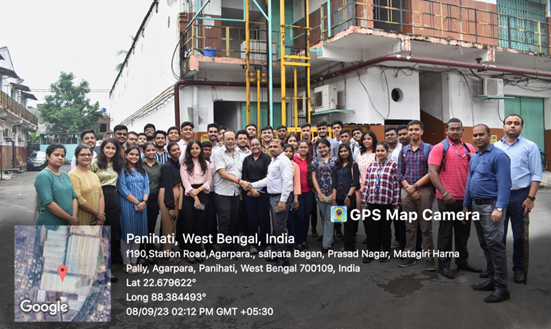
On September 8th, 2023, the Department of Business Administration of The Bhawanipur Education Society College conducted an Industrial Visit to the Amul Macho factory situated in Agarpara, West Bengal. The final year students of the Business Administration department were taken for the Visit,
organised by Department Coordinator, Dr. Tridib Sengupta. Though it was officially an industrial visit, the true purpose was much deeper. Not only did we visit the factory but also learn about the functioning of the entire unit.
Amul Macho is a well-known producer of inner wear in India, and it currently holds the tenth position in the garment industry. They have two units in Agarpara where the men’s garments are made from scratch. It has gained immense expertise in the supplying and trading of gent’s undergarments, T-shirt, pants, etc. The unit has a capacity to produce approximately 24,000 units per day, with a direct employment of about 1000-1200 workers, inclusive of both male and female.
The Amul Macho products sold in the markets are made from scratch through inclusion of several processes consecutively that give out the finished product of the best quality.
A group consisting of 43 marketing students including a student- reporter and a student-photographer visited the site. The students accompanied by the class coordinator Prof. Jayjit Chakraborty started the trip at 10:50 a.m. and reached the site at around 12:50p.m. Students were provided refreshments on their way to the factory by the college. The office staff at the factory welcomed the group warmly and proceeded to present the workings of the factory and provide a guided tour to the students. Supervisor of each department briefed students about the various steps involved in the garment producing process.
The first process is known as Knitting, which involves creating fabric by interlocking yarns together using knitting machines. Different types of knitting techniques, such as circular knitting or flat knitting, can be used depending on the desired fabric structure. The process starts with selecting the appropriate yarn and setting up the knitting machine with the desired stitch pattern. The machine knits the yarns together to form the fabric. After knitting, the fabric goes through other processes like dyeing, printing, and garment construction.
The next step in the process is to dye the fabrics in required colours. After the Knitting process, the fabric is sent to a vendor, in bulk, for the Dyeing process. The dyed fabric then goes for a quality check. There is a separate testing laboratory in the factory where the colour quality, shrinkage of cloth, tear, stain, creases or defects are inspected manually to provide only the safest and best quality materials to the consumers. These fabrics are then sent to Cutting section. The factory uses cutting machines made by MORGAN and GERBER and CAD software for the fabrics to be cut to perfection.
The third step is the process of Assimilation and Stitching which involves bringing together various fabric pieces to create a finished garment. First, the fabric pieces are aligned and pinned together according to the garment pattern. Then, skilled workers use sewing machines or hand stitching techniques to stitch the pieces together, following specific stitching guidelines and seam allowances. This process ensures that the garment fits properly and maintains its shape. After stitching, additional steps like pressing, trimming excess threads, and adding finishing touches are carried out to give the garment a polished look. Additionally elastic bands are cut, designed, and attached to the garment of different sizes and qualities based on demand. It is an important step in transforming the fabric into a stylish and wearable garment.
In the final process, after the garments are stitched, they undergo a thorough inspection to check for any defects or inconsistencies in stitching, measurements, or overall appearance. Once the garments pass the inspection, the next step is logo printing. This involves applying the brand’s logo or any other designs onto the garments using techniques like screen printing, heat transfer, or embroidery. Finally, the garments are carefully folded, packed, and labelled according to the brand’s specifications. This process ensures that the garments are ready for distribution and display, maintaining the brand’s image and delivering a high-quality product to customers.
Student interaction with the staff from the various departments provided a holistic view of the factory. The visit was quite interactive and informative as they got to know about the various manufacturing processes that go on in garment production. It was an enthralling experience for the students as it will help them to get a foothold in the corporate world. A token of appreciation in the form of a Memento was presented to the Factory Manager of Amul Macho, Agarpara. Altogether, the visit to the Amul Macho factory was a remarkable experience.
Thus, ‘Industrial Visits’ are the most practical approach towards learning through interaction, working practices, etc. and give a perfect reality check to the students.
Department: Economics in association with NSS, The BES College Date: 10th July 2024 No. of participants: 23 semester 4 students from the Department of Economics, 5 NSS volunteers, 6 faculty members, 20 school children from Panch Darshiya Vidyalaya, Kolkata and 3 members of HUM, an NGO On 10th July 2024, the Department of Economics, in …
A team of Quiz Masters from Derek O’Brien and Associates had come down to the Bhawanipur Education Society College (BESC) on August 26th 2017, to conduct a quizzing session of 5 rounds of 8 questions each. On a higher plane, their mission was to foster the love for quizzing in the campus and make the already …
Name of the Activity: Felicitation Ceremony and Interactive Session with the Toppers of the Batch of 2021-2024 Type of Activity: Academic Time: 1PM Details of Resource persons (Name, Designation, Affiliation, Area of Specialisation, etc): NA No. of Participants: 31 Objective of the event: The objective of the event was to felicitate the toppers of the …
The term Induction literally refers to the action or process of inducting someone to a post or an organisation. Viewed from this level, the process of Induction – and the elaborate rituals that accompany it – is just a ceremony where “freshers”, new students are formally embraced into the fraternity of the Bhawanipur Education Society …
Industrial visit to Amul Macho Factory, Agarpara
On September 8th, 2023, the Department of Business Administration of The Bhawanipur Education Society College conducted an Industrial Visit to the Amul Macho factory situated in Agarpara, West Bengal. The final year students of the Business Administration department were taken for the Visit,
organised by Department Coordinator, Dr. Tridib Sengupta. Though it was officially an industrial visit, the true purpose was much deeper. Not only did we visit the factory but also learn about the functioning of the entire unit.
Amul Macho is a well-known producer of inner wear in India, and it currently holds the tenth position in the garment industry. They have two units in Agarpara where the men’s garments are made from scratch. It has gained immense expertise in the supplying and trading of gent’s undergarments, T-shirt, pants, etc. The unit has a capacity to produce approximately 24,000 units per day, with a direct employment of about 1000-1200 workers, inclusive of both male and female.
The Amul Macho products sold in the markets are made from scratch through inclusion of several processes consecutively that give out the finished product of the best quality.
A group consisting of 43 marketing students including a student- reporter and a student-photographer visited the site. The students accompanied by the class coordinator Prof. Jayjit Chakraborty started the trip at 10:50 a.m. and reached the site at around 12:50p.m. Students were provided refreshments on their way to the factory by the college. The office staff at the factory welcomed the group warmly and proceeded to present the workings of the factory and provide a guided tour to the students. Supervisor of each department briefed students about the various steps involved in the garment producing process.
The first process is known as Knitting, which involves creating fabric by interlocking yarns together using knitting machines. Different types of knitting techniques, such as circular knitting or flat knitting, can be used depending on the desired fabric structure. The process starts with selecting the appropriate yarn and setting up the knitting machine with the desired stitch pattern. The machine knits the yarns together to form the fabric. After knitting, the fabric goes through other processes like dyeing, printing, and garment construction.
The next step in the process is to dye the fabrics in required colours. After the Knitting process, the fabric is sent to a vendor, in bulk, for the Dyeing process. The dyed fabric then goes for a quality check. There is a separate testing laboratory in the factory where the colour quality, shrinkage of cloth, tear, stain, creases or defects are inspected manually to provide only the safest and best quality materials to the consumers. These fabrics are then sent to Cutting section. The factory uses cutting machines made by MORGAN and GERBER and CAD software for the fabrics to be cut to perfection.
The third step is the process of Assimilation and Stitching which involves bringing together various fabric pieces to create a finished garment. First, the fabric pieces are aligned and pinned together according to the garment pattern. Then, skilled workers use sewing machines or hand stitching techniques to stitch the pieces together, following specific stitching guidelines and seam allowances. This process ensures that the garment fits properly and maintains its shape. After stitching, additional steps like pressing, trimming excess threads, and adding finishing touches are carried out to give the garment a polished look. Additionally elastic bands are cut, designed, and attached to the garment of different sizes and qualities based on demand. It is an important step in transforming the fabric into a stylish and wearable garment.
In the final process, after the garments are stitched, they undergo a thorough inspection to check for any defects or inconsistencies in stitching, measurements, or overall appearance. Once the garments pass the inspection, the next step is logo printing. This involves applying the brand’s logo or any other designs onto the garments using techniques like screen printing, heat transfer, or embroidery. Finally, the garments are carefully folded, packed, and labelled according to the brand’s specifications. This process ensures that the garments are ready for distribution and display, maintaining the brand’s image and delivering a high-quality product to customers.
Student interaction with the staff from the various departments provided a holistic view of the factory. The visit was quite interactive and informative as they got to know about the various manufacturing processes that go on in garment production. It was an enthralling experience for the students as it will help them to get a foothold in the corporate world. A token of appreciation in the form of a Memento was presented to the Factory Manager of Amul Macho, Agarpara. Altogether, the visit to the Amul Macho factory was a remarkable experience.
Thus, ‘Industrial Visits’ are the most practical approach towards learning through interaction, working practices, etc. and give a perfect reality check to the students.
Related Posts
Eco-Express – An Outreach-cum-Extension Programme
Department: Economics in association with NSS, The BES College Date: 10th July 2024 No. of participants: 23 semester 4 students from the Department of Economics, 5 NSS volunteers, 6 faculty members, 20 school children from Panch Darshiya Vidyalaya, Kolkata and 3 members of HUM, an NGO On 10th July 2024, the Department of Economics, in …
What’s the right answer? Q’URIOUSITY finds out
A team of Quiz Masters from Derek O’Brien and Associates had come down to the Bhawanipur Education Society College (BESC) on August 26th 2017, to conduct a quizzing session of 5 rounds of 8 questions each. On a higher plane, their mission was to foster the love for quizzing in the campus and make the already …
Felicitation Ceremony and Interactive Session with the Toppers of the Batch of 2021-2024
Name of the Activity: Felicitation Ceremony and Interactive Session with the Toppers of the Batch of 2021-2024 Type of Activity: Academic Time: 1PM Details of Resource persons (Name, Designation, Affiliation, Area of Specialisation, etc): NA No. of Participants: 31 Objective of the event: The objective of the event was to felicitate the toppers of the …
BESC fires up the Induction Furnace
The term Induction literally refers to the action or process of inducting someone to a post or an organisation. Viewed from this level, the process of Induction – and the elaborate rituals that accompany it – is just a ceremony where “freshers”, new students are formally embraced into the fraternity of the Bhawanipur Education Society …