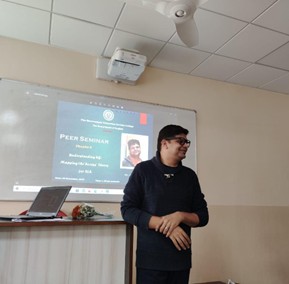
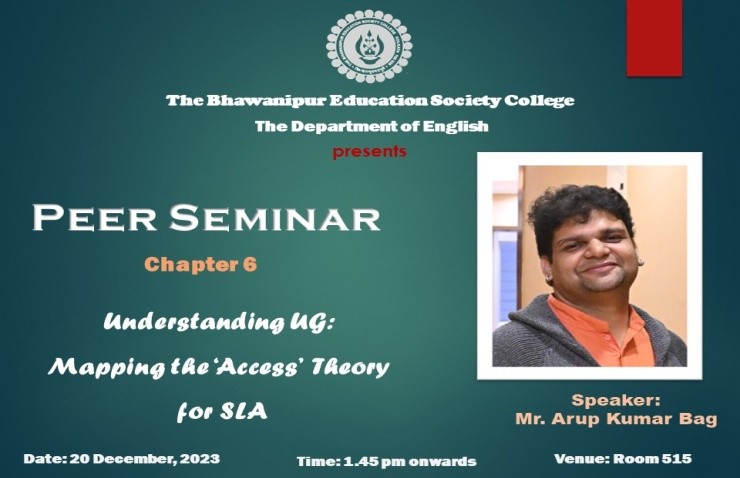
The Peer Seminars are a unique monthly endeavour by the Department of English, The Bhawanipur Education Society. The primary objective for initiating and curating such a unique exertion is to create an exposure for students and inspire them for research and higher education. The Department of English, The Bhawanipur Education Society College organized Peer Seminar Chapter: 6 on 20th December, 2023 at 1:45 pm. The speaker was Mr. Arup Kumar Bag; his paper was entitled- “Understanding UG: Mapping the ‘Access’ Theory for SLA”. The seminar took place in room no. 515, and was attended by the faculty members and the PG Semester III students of the Department of English.
Mr. Bag is a Ph. D scholar and is currently doing his research on English Language Teaching (ELT), and English Language Education (ELE). Second Language Acquisition (SLA), and ‘Error Analysis’ being his prime focus, Mr. Bag began his presentation by locating the discourse of language acquisition in terms of L1, L2, and TL [Target Language]. His presentation probed deeper into the Chomskian legacy of ‘Innate approach’ and how language is biologically ‘pre-determined’ through the LAD. Chomskian paradigm shifted its focus from LAD to UG where Chomsky believed that it is presupposed that the linguistic competence of native speakers of a language can be accounted for in terms of an abstract and unconscious linguistic system, in other words, a grammar, which underlies the use of language which he termed later as UG.
Mr. Bag commented on the four important hypotheses of UG developed chronologically by different scholars- The Minimal Trees Hypothesis: developed by A. Vainikka and M.Young Scholten in 1994; The Full Transfer Full Access Hypothesis developed B. Schwartz and R. Sprouse in 1996; The Valueless Features Hypothesis developed by L. Eubank in 1996; and The Full Access (Without Transfer) Hypothesis by S. Flynn, G. Martohardjono, and S. Epstein in 1996. After a thorough literature review, Mr. Bag addressed certain research gaps in the mainstream research of ELE, and raised some questions such as- Why ‘First Language’ has been used in a general sense in all the previous analysis, rather than focusing on individual linguistic systems; Why ‘Errors’ have been taken into consideration in ‘Performance’ where there has been Full Access of linguistic data; and finally, if at all we can associate errors with performance or not.
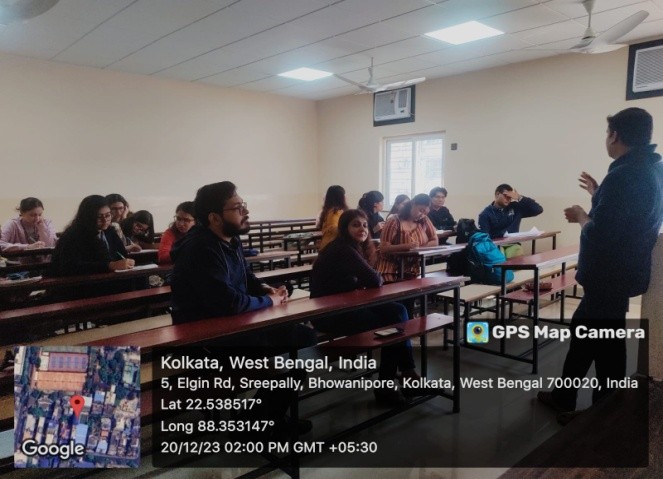
Mr. Bag’s presentation ended with a discussion where he addressed the recent developments in SLA theories in terms of UG and the problems associated with it. He also tried to enhance the interest in students be giving them examples from our day-to-day life and how these linguistic structures get registered in our schema without our realization.
“Yaa Devi Sarva-Bhutessu Shakti-Ruupenna Samsthitaa. Namas-Tasyai Namas-Tasyai Namas-Tasyai Namo Namah.” To celebrate the beginning of “Debipokhho”, i.e., the arrival of the Goddess, and welcome the victory of good over evil, The Bhawanipur Education Society College celebrated the auspicious occasion of Sharodiya creating history in its books. On 3rd October, 2024 for the very first time, …
“Data is a tool for enhancing intuition.” – Hilary Mason On 2nd March, 2022, Eco for Be-ites collective of The Bhawanipur Education Society College organised a seminar on Data Science. The speaker for the event was Professor Amit Das. Professor Amit Das has a B.Tech in Electronics Engineering from IIT Kharagpur, and a post-graduate …
The Department of Political Science organized a Prize Distribution Ceremony on June 24, 2023 in Jubilee Hall for the students of Semester IV, to recognise their achievements in all types of academic and disciplinary activities during the semester. The proceedings of the prize distribution ceremony were conducted by Amala Dhandhania, Associate Professor, Department of Political …
Sponsored by Inclusion and Diversity Fund, Royal Society of Chemistry, London In Collaboration with Indian Chemical Society, Kolkata, India The Department of Chemistry, The Bhawanipur Education Society College in collaboration with Indian Chemical Society, Kolkata organized one-day seminar entitled “Chemistry Behind Phytochemicals Used as Herbal Medicines for the Treatment of Diseases of Human Being” on …
Report- Peer Seminar: 6- Arup Kumar Bag
The Peer Seminars are a unique monthly endeavour by the Department of English, The Bhawanipur Education Society. The primary objective for initiating and curating such a unique exertion is to create an exposure for students and inspire them for research and higher education. The Department of English, The Bhawanipur Education Society College organized Peer Seminar Chapter: 6 on 20th December, 2023 at 1:45 pm. The speaker was Mr. Arup Kumar Bag; his paper was entitled- “Understanding UG: Mapping the ‘Access’ Theory for SLA”. The seminar took place in room no. 515, and was attended by the faculty members and the PG Semester III students of the Department of English.
Mr. Bag is a Ph. D scholar and is currently doing his research on English Language Teaching (ELT), and English Language Education (ELE). Second Language Acquisition (SLA), and ‘Error Analysis’ being his prime focus, Mr. Bag began his presentation by locating the discourse of language acquisition in terms of L1, L2, and TL [Target Language]. His presentation probed deeper into the Chomskian legacy of ‘Innate approach’ and how language is biologically ‘pre-determined’ through the LAD. Chomskian paradigm shifted its focus from LAD to UG where Chomsky believed that it is presupposed that the linguistic competence of native speakers of a language can be accounted for in terms of an abstract and unconscious linguistic system, in other words, a grammar, which underlies the use of language which he termed later as UG.
Mr. Bag commented on the four important hypotheses of UG developed chronologically by different scholars- The Minimal Trees Hypothesis: developed by A. Vainikka and M.Young Scholten in 1994; The Full Transfer Full Access Hypothesis developed B. Schwartz and R. Sprouse in 1996; The Valueless Features Hypothesis developed by L. Eubank in 1996; and The Full Access (Without Transfer) Hypothesis by S. Flynn, G. Martohardjono, and S. Epstein in 1996. After a thorough literature review, Mr. Bag addressed certain research gaps in the mainstream research of ELE, and raised some questions such as- Why ‘First Language’ has been used in a general sense in all the previous analysis, rather than focusing on individual linguistic systems; Why ‘Errors’ have been taken into consideration in ‘Performance’ where there has been Full Access of linguistic data; and finally, if at all we can associate errors with performance or not.
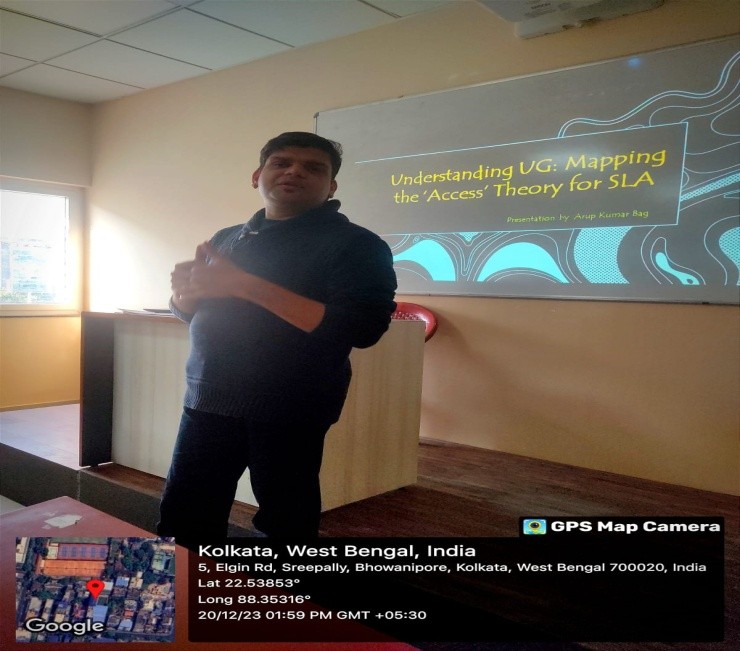
Mr. Bag’s presentation ended with a discussion where he addressed the recent developments in SLA theories in terms of UG and the problems associated with it. He also tried to enhance the interest in students be giving them examples from our day-to-day life and how these linguistic structures get registered in our schema without our realization.
Related Posts
Sharodiya 2024
“Yaa Devi Sarva-Bhutessu Shakti-Ruupenna Samsthitaa. Namas-Tasyai Namas-Tasyai Namas-Tasyai Namo Namah.” To celebrate the beginning of “Debipokhho”, i.e., the arrival of the Goddess, and welcome the victory of good over evil, The Bhawanipur Education Society College celebrated the auspicious occasion of Sharodiya creating history in its books. On 3rd October, 2024 for the very first time, …
Seminar on Data Science
“Data is a tool for enhancing intuition.” – Hilary Mason On 2nd March, 2022, Eco for Be-ites collective of The Bhawanipur Education Society College organised a seminar on Data Science. The speaker for the event was Professor Amit Das. Professor Amit Das has a B.Tech in Electronics Engineering from IIT Kharagpur, and a post-graduate …
PRIZE DISTRIBUTION CEREMONY FOR ACADEMIC AND DISCIPLINARY MEASURES (SEMESTER IV)
The Department of Political Science organized a Prize Distribution Ceremony on June 24, 2023 in Jubilee Hall for the students of Semester IV, to recognise their achievements in all types of academic and disciplinary activities during the semester. The proceedings of the prize distribution ceremony were conducted by Amala Dhandhania, Associate Professor, Department of Political …
CHEMISTRY BEHIND PHYTOCHEMICALS USED AS HERBAL MEDICINES FOR THE TREATMENT OF DISEASES OF HUMAN BEING
Sponsored by Inclusion and Diversity Fund, Royal Society of Chemistry, London In Collaboration with Indian Chemical Society, Kolkata, India The Department of Chemistry, The Bhawanipur Education Society College in collaboration with Indian Chemical Society, Kolkata organized one-day seminar entitled “Chemistry Behind Phytochemicals Used as Herbal Medicines for the Treatment of Diseases of Human Being” on …