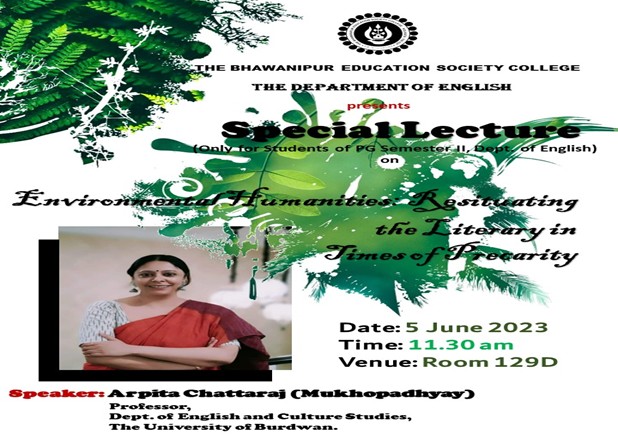
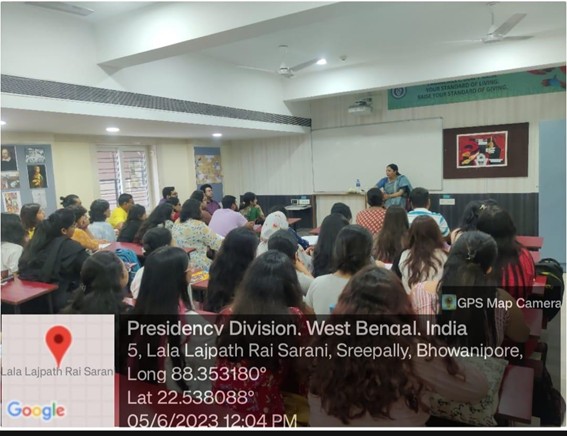
The Department of English organized a special lecture on Environmental Humanities for the Second semester students of the Postgraduate course, on June 5, 2023 at 11:30 am in the college premises. The special lecture entitled “Environmental Humanities: Resituating the Literary in Times of Precarity” was delivered by Prof. (Dr.) Arpita Chattaraj Mukhopadhyay of the Department of English and Culture Studies, The University of Burdwan. The lecture had the objective of providing students with a background knowledge on environmental humanities, an emerging area of interdisciplinary studies that links humanities to sustainable development and a plethora of environmental concerns.
Dr. Chattaraj Mukhopadhyay started the lecture by defining environmental humanities as a discipline that emphasized the inextricability of environment and humanities. Environmental Humanities as a discipline is predicated on the transgression of multiple disciplinary borders and the transcendence of the bifurcations inherent in Western Literary theory. The definition also referred to the possibility of treating literature from an ethical perspective. At the very onset, the lecture raised a concern with the overwhelming planetary crisis facing all humanity due to industrialization and urbanization. In this context it traced the importance of literature in addressing these concerns through a literary representation of the world. Literature was then redefined as a participatory archive that uses narratives to embody lived experiences, imaginings and that often seeks to project anticipated events. From the viewpoint of environmental humanities, one of the fundamental questions raised by literature is centered upon the definition of what constitutes the definition and the situatedness of the ‘human’. The lecture traced the ways in which earth history, world history, human history and natural history are intertwined. It referred to Dipesh Chakravarty’s concept of the ‘Anthropocene’ and the great ontological collapse between natural and human histories. Chakravarty’s segregation of the terms ‘human-human’ and non-human human’ were elaborated with special emphasis on the self-reflexivity that accompanies the idea of the human, as opposed to the definition of the ‘non-human’. This was explained in terms of the historical example of the Permanent Settlement in Bengal as a means of exerting the colonial masters’ right to water and land. The concluding sections of the lecture addressed the various ways in which literature made readers critically aware of human self-reflexivity and at the same time, considered the futility of this awareness. It drew upon the example of Margaret Atwood’s story “Time Capsule Found on the Dead Planet” to illustrate this. The lecture concluded with an optimistic emphasis on the capability of literature to save the planet by quoting the popular song “Gaon Chor ap Nahi” sung by Bhagwan Majhi. The lecture was received with immense enthusiasm by the students of the Postgraduate Department followed by a Q/A session.
The Bhawanipur Education Society College conducted a Salsa workshop on August 31, 2014. The workshop saw a large turnout, and enthusiastic students participated with great energy and excitement to learn the moves of Salsa.
Antakshari is a spoken parlour game played in India, Bangladesh, Pakistan and Nepal. Each contestant sings the first verse of a song that begins with the Hindustani consonant on which the previous contestant’s song ends. The first event on the second day of Umang’14 was Antakshari which was held at the main stage.
Interlocutor (ISSN: 2583-7915) an online, annual peer-reviewed journal of the Department of English organised a special talk by Prof. Niladri R. Chatterjee (Professor and HOD, Department of English, Kalyani University), as a part of Special Lecture Series, Chapter 1 (Topic, – “Just Good Friends”: The Floating Signifier of Friendship). The event was held on 3rd …
Special Lecture on Environmental Humanities organized for the Postgraduate Students of the Department of English
The Department of English organized a special lecture on Environmental Humanities for the Second semester students of the Postgraduate course, on June 5, 2023 at 11:30 am in the college premises. The special lecture entitled “Environmental Humanities: Resituating the Literary in Times of Precarity” was delivered by Prof. (Dr.) Arpita Chattaraj Mukhopadhyay of the Department of English and Culture Studies, The University of Burdwan. The lecture had the objective of providing students with a background knowledge on environmental humanities, an emerging area of interdisciplinary studies that links humanities to sustainable development and a plethora of environmental concerns.
Dr. Chattaraj Mukhopadhyay started the lecture by defining environmental humanities as a discipline that emphasized the inextricability of environment and humanities. Environmental Humanities as a discipline is predicated on the transgression of multiple disciplinary borders and the transcendence of the bifurcations inherent in Western Literary theory. The definition also referred to the possibility of treating literature from an ethical perspective. At the very onset, the lecture raised a concern with the overwhelming planetary crisis facing all humanity due to industrialization and urbanization. In this context it traced the importance of literature in addressing these concerns through a literary representation of the world. Literature was then redefined as a participatory archive that uses narratives to embody lived experiences, imaginings and that often seeks to project anticipated events. From the viewpoint of environmental humanities, one of the fundamental questions raised by literature is centered upon the definition of what constitutes the definition and the situatedness of the ‘human’. The lecture traced the ways in which earth history, world history, human history and natural history are intertwined. It referred to Dipesh Chakravarty’s concept of the ‘Anthropocene’ and the great ontological collapse between natural and human histories. Chakravarty’s segregation of the terms ‘human-human’ and non-human human’ were elaborated with special emphasis on the self-reflexivity that accompanies the idea of the human, as opposed to the definition of the ‘non-human’. This was explained in terms of the historical example of the Permanent Settlement in Bengal as a means of exerting the colonial masters’ right to water and land. The concluding sections of the lecture addressed the various ways in which literature made readers critically aware of human self-reflexivity and at the same time, considered the futility of this awareness. It drew upon the example of Margaret Atwood’s story “Time Capsule Found on the Dead Planet” to illustrate this. The lecture concluded with an optimistic emphasis on the capability of literature to save the planet by quoting the popular song “Gaon Chor ap Nahi” sung by Bhagwan Majhi. The lecture was received with immense enthusiasm by the students of the Postgraduate Department followed by a Q/A session.
Related Posts
Salsa Workshop
The Bhawanipur Education Society College conducted a Salsa workshop on August 31, 2014. The workshop saw a large turnout, and enthusiastic students participated with great energy and excitement to learn the moves of Salsa.
BESC celebrates the Republic Day
The Republic Day was celebrated with full solemnity by the teachers and students of the Bhawanipur Education Society College (BESC).
Umang 2014: Antakshari
Antakshari is a spoken parlour game played in India, Bangladesh, Pakistan and Nepal. Each contestant sings the first verse of a song that begins with the Hindustani consonant on which the previous contestant’s song ends. The first event on the second day of Umang’14 was Antakshari which was held at the main stage.
Interlocutor: An online, annual peer-reviewed journal
Interlocutor (ISSN: 2583-7915) an online, annual peer-reviewed journal of the Department of English organised a special talk by Prof. Niladri R. Chatterjee (Professor and HOD, Department of English, Kalyani University), as a part of Special Lecture Series, Chapter 1 (Topic, – “Just Good Friends”: The Floating Signifier of Friendship). The event was held on 3rd …