Organized by the Department of Business Administration, The Bhawanipur Education Society College
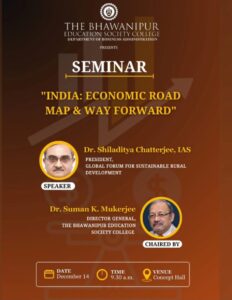
Date: 14 December 2024 Venue: Concept Hall Chaired by: Professor Dr. Suman Kumar Mukerjee, Director General Speaker: Dr. Shiladitya Chatterjee, IAS, President of Global Forum for Sustainable Rural Development Coordinated by: Dr. Tridib Sengupta, Coordinator, Department of Business Administration
Introduction:
The Department of Business Administration of The Bhawanipur Education Society College conducted an insightful seminar titled *India: Economic Roadmap and Way Forward*, aimed at fostering understanding and dialogue on the economic challenges and opportunities facing India. The session was chaired by Professor Dr. Suman Kumar Mukerjee, Director General of the college. Dr. Shiladitya Chatterjee, IAS, the President of the Global Forum for Sustainable Rural Development, was the keynote speaker.
Welcome Address:
The seminar commenced with a welcome address by Professor Dr. Suman Kumar Mukerjee, who emphasized critical issues such as the widening gap between the rich and the poor, the challenges posed by low employment, the decreasing workforce, and the technological factors influencing economic growth. Dr. Mukerjee also explored potential pathways for India’s economic progress, highlighting the importance of addressing these challenges strategically.
Keynote Address by Dr. Shiladitya Chatterjee Dr. Shiladitya Chatterjee began his presentation by providing a comprehensive analysis of India’s economic landscape. He discussed key drivers of India’s growth, including:
– Fiscal Deficit: Its impact on the economy and strategies for managing it.
– Demographic Dividend: The potential of India’s young population, along with the associated risks if not properly harnessed.
– Recent Economic Measures: The implementation of infrastructure pushes, Goods and Services Tax (GST), and digitalization, all contributing to economic growth.
Dr. Chatterjee also addressed India’s standing in terms of per capita income, noting that the country still faces significant disparities compared to global standards. He underscored the challenges posed by high unemployment rates, particularly in Asia, and the possibility of India’s demographic dividend turning into a curse if not effectively utilized.
Discussion on India’s Development and Comparative Analysis:
Dr. Chatterjee compared India’s performance with other nations on various human development indicators, highlighting that India lags behind many countries in critical aspects such as education, healthcare, and overall human development. He also elaborated on the potential threats to India’s continued economic growth, including:
– Climate Change: The severe impact of climate change on India and South Asia, particularly through increased heatwaves, floods, and cyclones.
– Income Inequality: The widening income gap, particularly in the welfare sector, which hampers overall growth.
To illustrate the socio-economic divide, Dr. Chatterjee displayed a map of India, categorizing regions based on income levels: low-income, middle-income, and high-income groups.
Sustainable Development Goals (SDGs)
Dr. Chatterjee then emphasized the importance of the 17 Sustainable Development Goals (SDGs) set by the United Nations, which every country should follow. He focused on three key dimensions of sustainable development: economic, social, and environmental factors. India’s progress toward these goals was discussed in the context of structural changes required for long-term growth.
He also cautioned about the **Middle-Income Trap**, warning that India is at risk of stagnating in the middle-income category due to challenges in areas such as production growth, education, human development, innovation, and technology. He pointed out that structural changes towards industrialization have not yet materialized in India, which could hinder the country’s progression to a higher economic status.
Microeconomic Stability:
In his concluding remarks, Dr. Chatterjee highlighted India’s achievement of microeconomic stability, which he believes is a strong foundation for the country’s future growth. He emphasized the need for sustained efforts in addressing income inequality, skill development, and innovation to ensure that India’s economic trajectory remains upward.
Insights from the Chair:
Following the keynote address, Professor Dr. Suman Kumar Mukerjee shared his insights on critical issues such as the calculation of inequality and absolute poverty. He discussed the importance of targeting these issues to ensure inclusive growth. Additionally, he stressed the relevance of Sustainable Development Goals in guiding India’s long-term development strategies.
Rebuttal and Q&A Session
The session concluded with a rebuttal and question-answer session, where students actively engaged with Dr. Chatterjee and Professor Mukerjee, seeking clarifications on various aspects of India’s economic challenges and solutions.
Vote of Thanks:
The seminar concluded with a vote of thanks delivered by Dr. Tridib Sengupta, Coordinator of the Department of Business Administration, who expressed gratitude to the speakers, attendees, and organizers for their contributions to the success of the seminar.
Conclusion:
The seminar provided a platform for in-depth discussions on the various challenges and opportunities in India’s economic growth trajectory. The insights shared by Dr. Shiladitya Chatterjee and Professor Dr. Suman Kumar Mukerjee were thought-provoking and highlighted the importance of addressing key issues such as unemployment, inequality, and climate change. The discussions on Sustainable Development Goals and India’s future prospects were particularly enlightening, offering a roadmap for overcoming the hurdles that India faces in its journey towards sustained growth.
Report Prepared By:
Department of Business Administration
The Bhawanipur Education Society College
“Tradition is not the worship of ashes, but the preservation of fire.” – Gustav Mahler Our home, India, is not just a country but a civilization known for its diversity, inclusivity, and the richness of its communities. Similarly, The Bhawanipur Education Society College is known for its efforts in upholding Indian traditions and celebrating our …
The Department of History conducted a students’ presentation on May 4, 2023 where final year students Rajarshi Dutta and Neeladri Adhikary presented their research to their colleagues and members of the faculty. Rajarshi Dutta’s paper studied the strategies, techniques and methods deployed by the Vietnamese forces against US in the Vietnam War (1955-1975). The theoretical …
Have you ever designed something? Have you considered your customers thought process when he/she buys your product? Have you analysed how your product is treated at a customer’s house? Well I am sure the latter two are something we all never thought about. Not only did one student agree to this, but a full majority …
A special lecture on Rabindranath Tagore by Professor Radha Chakravarty was organized by the Department of English, The Bhawanipur Education Society College on 10.07.2021 from 6.00 p.m. to 7.30 p.m. for the students of the Department of English. Professor Chakravarty teaches Comparative Literature & Translation Studies at Ambedkar University, Delhi. A renowned writer, critic and …
Report on Seminar: India – Economic Roadmap and Way Forward
Organized by the Department of Business Administration, The Bhawanipur Education Society College
Date: 14 December 2024
Venue: Concept Hall
Chaired by: Professor Dr. Suman Kumar Mukerjee, Director General
Speaker: Dr. Shiladitya Chatterjee, IAS, President of Global Forum for Sustainable Rural Development
Coordinated by: Dr. Tridib Sengupta, Coordinator, Department of Business Administration
Introduction:
The Department of Business Administration of The Bhawanipur Education Society College conducted an insightful seminar titled *India: Economic Roadmap and Way Forward*, aimed at fostering understanding and dialogue on the economic challenges and opportunities facing India. The session was chaired by Professor Dr. Suman Kumar Mukerjee, Director General of the college. Dr. Shiladitya Chatterjee, IAS, the President of the Global Forum for Sustainable Rural Development, was the keynote speaker.
Welcome Address:
The seminar commenced with a welcome address by Professor Dr. Suman Kumar Mukerjee, who emphasized critical issues such as the widening gap between the rich and the poor, the challenges posed by low employment, the decreasing workforce, and the technological factors influencing economic growth. Dr. Mukerjee also explored potential pathways for India’s economic progress, highlighting the importance of addressing these challenges strategically.
Keynote Address by Dr. Shiladitya Chatterjee
Dr. Shiladitya Chatterjee began his presentation by providing a comprehensive analysis of India’s economic landscape. He discussed key drivers of India’s growth, including:
– Fiscal Deficit: Its impact on the economy and strategies for managing it.
– Demographic Dividend: The potential of India’s young population, along with the associated risks if not properly harnessed.
– Recent Economic Measures: The implementation of infrastructure pushes, Goods and Services Tax (GST), and digitalization, all contributing to economic growth.
Dr. Chatterjee also addressed India’s standing in terms of per capita income, noting that the country still faces significant disparities compared to global standards. He underscored the challenges posed by high unemployment rates, particularly in Asia, and the possibility of India’s demographic dividend turning into a curse if not effectively utilized.
Discussion on India’s Development and Comparative Analysis:
Dr. Chatterjee compared India’s performance with other nations on various human development indicators, highlighting that India lags behind many countries in critical aspects such as education, healthcare, and overall human development. He also elaborated on the potential threats to India’s continued economic growth, including:
– Climate Change: The severe impact of climate change on India and South Asia, particularly through increased heatwaves, floods, and cyclones.
– Income Inequality: The widening income gap, particularly in the welfare sector, which hampers overall growth.
To illustrate the socio-economic divide, Dr. Chatterjee displayed a map of India, categorizing regions based on income levels: low-income, middle-income, and high-income groups.
Sustainable Development Goals (SDGs)
Dr. Chatterjee then emphasized the importance of the 17 Sustainable Development Goals (SDGs) set by the United Nations, which every country should follow. He focused on three key dimensions of sustainable development: economic, social, and environmental factors. India’s progress toward these goals was discussed in the context of structural changes required for long-term growth.
He also cautioned about the **Middle-Income Trap**, warning that India is at risk of stagnating in the middle-income category due to challenges in areas such as production growth, education, human development, innovation, and technology. He pointed out that structural changes towards industrialization have not yet materialized in India, which could hinder the country’s progression to a higher economic status.
Microeconomic Stability:
In his concluding remarks, Dr. Chatterjee highlighted India’s achievement of microeconomic stability, which he believes is a strong foundation for the country’s future growth. He emphasized the need for sustained efforts in addressing income inequality, skill development, and innovation to ensure that India’s economic trajectory remains upward.
Insights from the Chair:
Following the keynote address, Professor Dr. Suman Kumar Mukerjee shared his insights on critical issues such as the calculation of inequality and absolute poverty. He discussed the importance of targeting these issues to ensure inclusive growth. Additionally, he stressed the relevance of Sustainable Development Goals in guiding India’s long-term development strategies.
Rebuttal and Q&A Session
The session concluded with a rebuttal and question-answer session, where students actively engaged with Dr. Chatterjee and Professor Mukerjee, seeking clarifications on various aspects of India’s economic challenges and solutions.
Vote of Thanks:
The seminar concluded with a vote of thanks delivered by Dr. Tridib Sengupta, Coordinator of the Department of Business Administration, who expressed gratitude to the speakers, attendees, and organizers for their contributions to the success of the seminar.
Conclusion:
The seminar provided a platform for in-depth discussions on the various challenges and opportunities in India’s economic growth trajectory. The insights shared by Dr. Shiladitya Chatterjee and Professor Dr. Suman Kumar Mukerjee were thought-provoking and highlighted the importance of addressing key issues such as unemployment, inequality, and climate change. The discussions on Sustainable Development Goals and India’s future prospects were particularly enlightening, offering a roadmap for overcoming the hurdles that India faces in its journey towards sustained growth.
Report Prepared By:
Department of Business Administration
The Bhawanipur Education Society College
Related Posts
Dhamaal 2024
“Tradition is not the worship of ashes, but the preservation of fire.” – Gustav Mahler Our home, India, is not just a country but a civilization known for its diversity, inclusivity, and the richness of its communities. Similarly, The Bhawanipur Education Society College is known for its efforts in upholding Indian traditions and celebrating our …
Students’ Presentation
The Department of History conducted a students’ presentation on May 4, 2023 where final year students Rajarshi Dutta and Neeladri Adhikary presented their research to their colleagues and members of the faculty. Rajarshi Dutta’s paper studied the strategies, techniques and methods deployed by the Vietnamese forces against US in the Vietnam War (1955-1975). The theoretical …
Design Thinking With Special Reference To Covid-19
Have you ever designed something? Have you considered your customers thought process when he/she buys your product? Have you analysed how your product is treated at a customer’s house? Well I am sure the latter two are something we all never thought about. Not only did one student agree to this, but a full majority …
Special lecture on Rabindranath Tagore
A special lecture on Rabindranath Tagore by Professor Radha Chakravarty was organized by the Department of English, The Bhawanipur Education Society College on 10.07.2021 from 6.00 p.m. to 7.30 p.m. for the students of the Department of English. Professor Chakravarty teaches Comparative Literature & Translation Studies at Ambedkar University, Delhi. A renowned writer, critic and …